
Editor’s note:
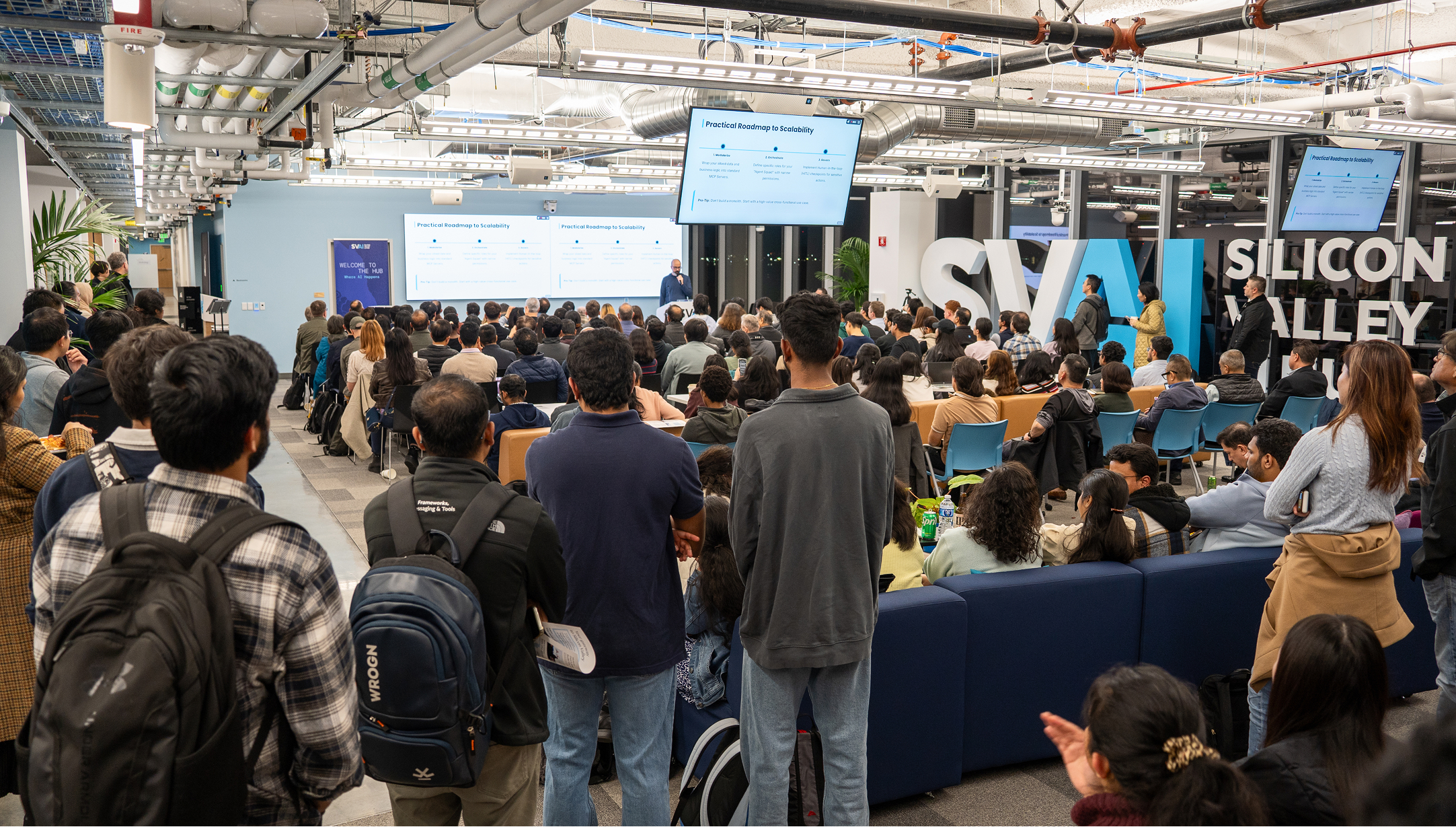
This article was originally written by Tony Moroney and is reposted here with permission. It draws on ideas discussed at the TechEquity Ai Summit 2025 and is shared to prompt deeper reflection on how organizations approach AI-led change.
At industry gatherings, there are moments when the signal cuts cleanly through the noise.
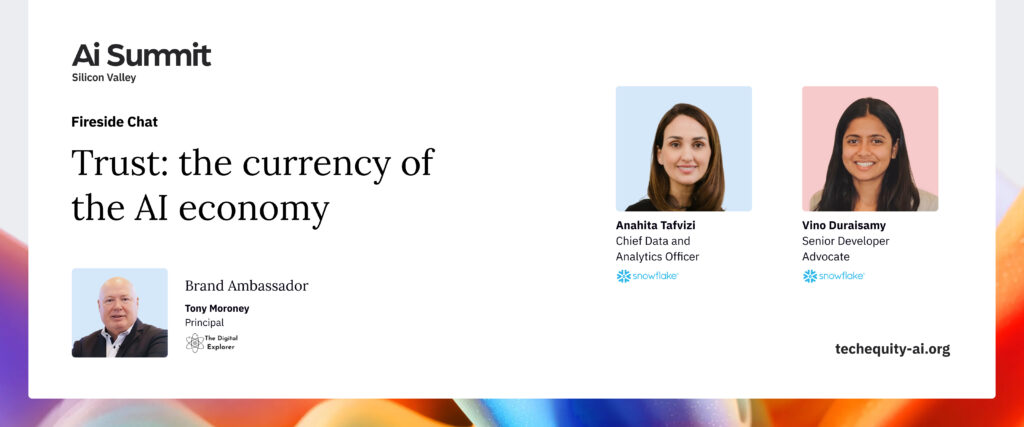
One such moment, at the Ai Summit by TechEquity Ai – Silicon Valley, came not from a product launch or a performance benchmark, but from a quieter, more unsettling provocation: algorithms will not derail enterprise AI—trust will.
Credit is due here. The conversation, shaped by Anahita Tafvizi and Vino Duraisamy, did not flatter the audience; it challenged them.
Their framing cut against the prevailing optimism of “AI everywhere” and exposed a harsher truth: without disciplined trust architectures, AI will not transform enterprises—it will industrialise confusion.
The Enterprise Illusion: More AI, Less Certainty
The dominant enterprise narrative suggests that scaling AI is primarily about access—more models, more data, more agents. Yet this narrative collapses under scrutiny.
As probabilistic systems are embedded directly into decision workflows—finance, operations, and customer engagement—organisations are discovering something uncomfortable: confidence is not the same as correctness.
AI agents do not hesitate. They respond fluently, persuasively, and at speed. In doing so, they expose a structural weakness many enterprises have learned to live with: leaders often cannot tell whether an answer is plausible or provable.
When decisions affect revenue recognition, risk exposure, or customer outcomes, that ambiguity is not merely academic. It becomes material.
This is not fundamentally a tooling issue. It is a leadership problem about how certainty is established, communicated, and trusted within complex organizations.
When Context Becomes the Bottleneck
For years, data leaders have warned of “garbage in, garbage out.” AI has raised the stakes. We now face something even more dangerous: chaos at scale.
Enterprises have spent decades accumulating dashboards, metrics, documents, and definitions—often inconsistent, redundant, or quietly outdated. When this fragmented reality is indexed wholesale and fed to AI systems, the result is not intelligence. It is amplification.
In this environment, context is no longer about volume. It is about coherence.
Shared definitions. Aligned business logic. Clear boundaries on what an AI system is authorised to answer—and what it must refuse. Without these, AI agents accelerate the organisation’s ability to disagree with itself, now with greater confidence and speed.
This is why trust cannot be retrofitted after deployment. It must be deliberately designed—layer by layer—before autonomy is granted.
Governance Is Not a Brake. It Is the Engine.
One of the most persistent myths in digital transformation is that governance slows innovation. In practice, the opposite is proving true.
Where trust mechanisms are weak, adoption stalls. Users test systems cautiously, encounter inconsistencies, and quietly disengage. Teams then spend their time explaining results, reconciling numbers, or correcting errors instead of innovating. Velocity collapses under its own weight.
By contrast, when accuracy thresholds are explicit, use cases are intentionally scoped, and accountability is visible, trust compounds. Users return. Systems improve. Innovation accelerates—not despite, but because of, governance.
In the AI era, governance is no longer a compliance exercise. It is the mechanism that enables organizations to move faster without losing credibility.
The New Mandate for Leaders: Certainty Before Scale
The rise of AI agents signals a deeper organisational shift.
Decisions once mediated by analysts, dashboards, and review cycles are now executed conversationally, often invisibly. That demands a new leadership approach.
Executives can no longer ask only what a system can do. They must also ask under what conditions it should be believed. Who defined the logic it relies on? Where does human judgment still intervene? And how does the organisation know when the system is wrong?
This is not about slowing ambition. It is about sequencing it correctly.
Narrow before broad. Verified before generative. Trusted before autonomous.
Stop Chasing Intelligence. Start Designing Trust.
The next phase of enterprise AI will not be won by those who deploy the most agents, index the most documents, or demo the slickest interfaces.
It will be led by organisations that understand a harder truth: trust is the currency of the AI economy—and most enterprises still operate without a central bank.
If you are a board member, ask how trust is measured, not just ROI. If you are an executive, demand clarity on where AI is allowed to decide—and where it must defer. If you are a data or technology leader, stop optimising for scale before coherence.
AI will not fail because it is too weak. It will fail because we were too careless with certainty.
The era of unchecked experimentation is drawing to a close. The era of accountable intelligence has begun.
Source and full original version available here:
https://www.linkedin.com/pulse/from-models-meaning-knowledge-new-operating-system-tony-moroney-yr6be/?trackingId=DO%2F5QMZWQAuCHRhb9KmWTQ%3D%3D