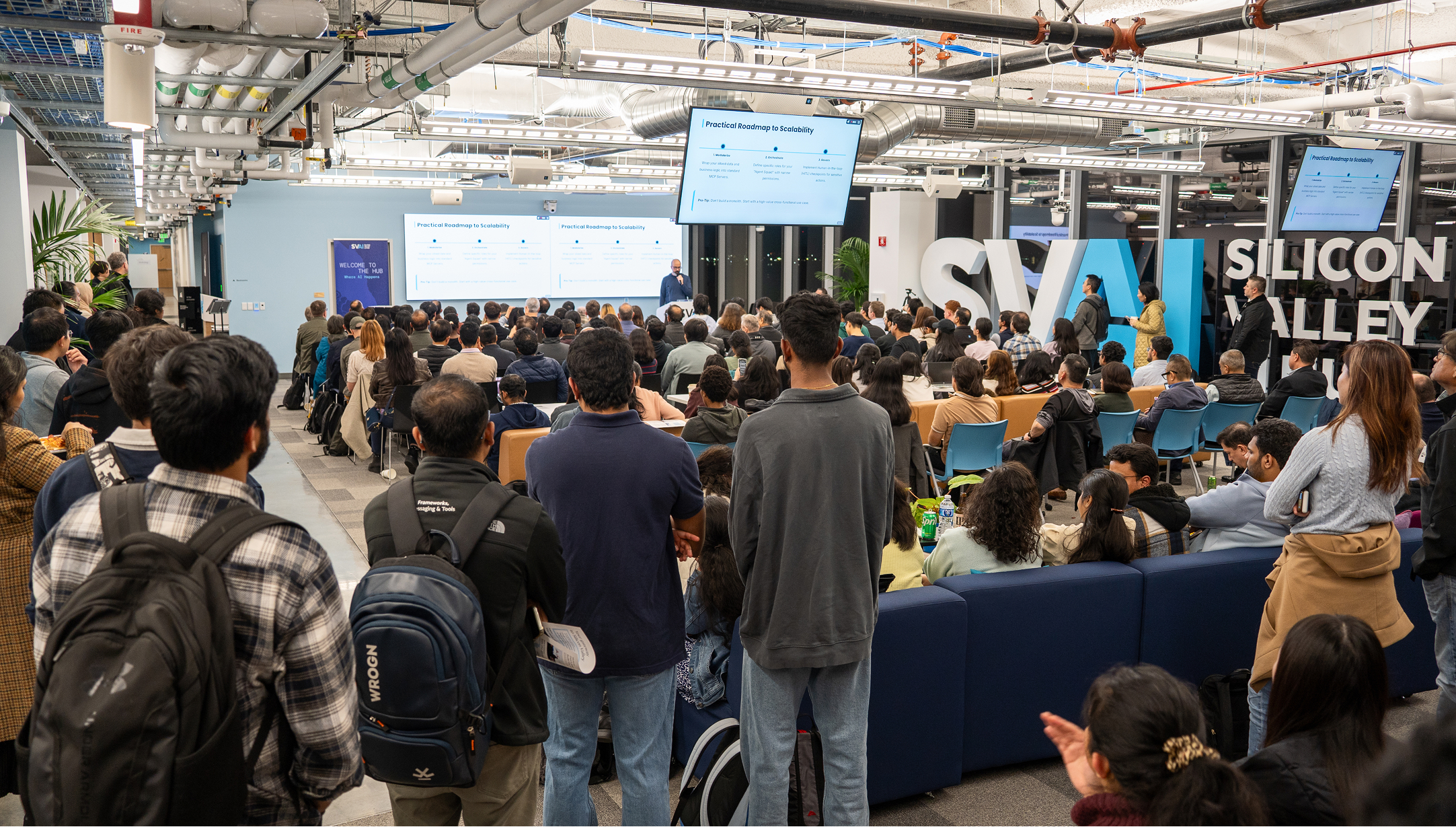

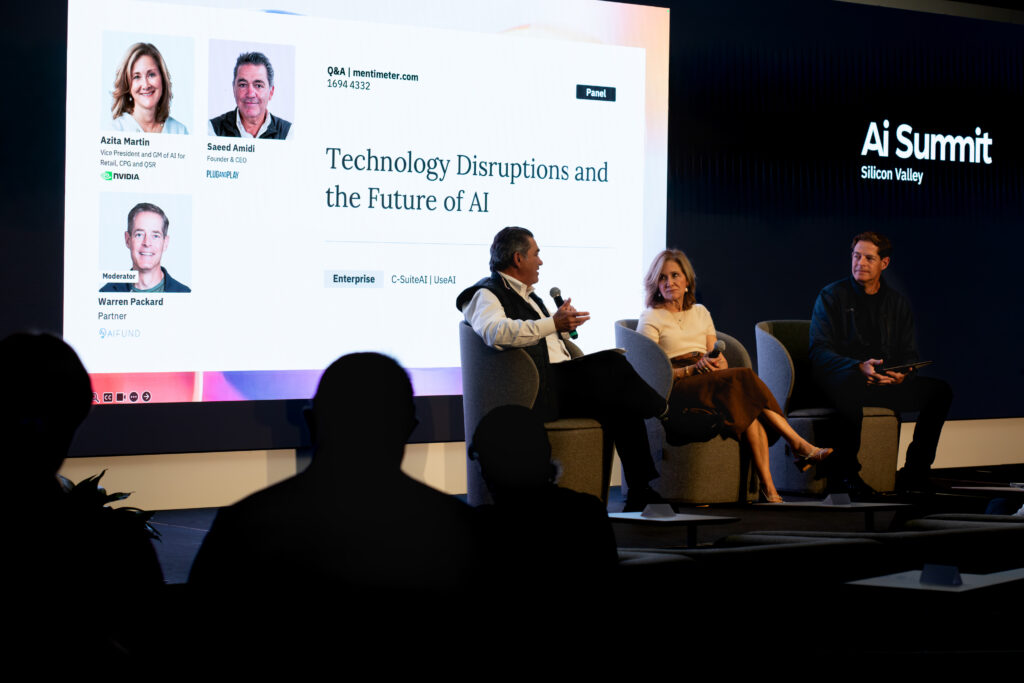
The 2025 TechEquity Ai Summit convened innovators, investors, policymakers, and builders for two days of forward-looking discussion, hands-on workshops, and industry-defining insights at Plug and Play Tech Center, Sunnyvale, CA. Held November 7–8, the Summit showcased how AI is shaping industries, informing policy, and driving responsible innovation.
Day 1: Building intelligence and exploring impact
Keynotes and C-suite perspectives
The Summit opened with keynote addresses from Keith Strier (AMD), Saeed Amidi (Plug and Play Tech Center), Azita Martin (NVIDIA), Warren Packard (AI Fund), and Kathi Vidal (Winston & Strawn LLP). Speakers explored how policy, ethics, and technical innovation intersect to shape responsible AI adoption and global progress.
Smart cities and mobility
The Smart Cities and Mobility panel featured leaders from Knightscope, Deloitte, Glydways, Samsara, and Faction. Discussions focused on intelligent infrastructure, urban mobility, and sustainability. Panelists shared real-world examples of how AI is improving connectivity and creating efficient, human-centered urban systems.
Workshops and hands-on learning
Intro to Agents workshops led by Sujee Maniyam (Nebius), Mike Prince (Matchwise AI), and Anupam Datta (Snowflake) offered practical experience in building AI agents. Attendees learned how GraphRAG and MCP frameworks translate theory into operational systems, covering design, evaluation, and deployment considerations.
BuildAI sessions showcased advanced architectures and collaboration models. Philip Rathle (Neo4j) demonstrated graph-based knowledge architectures that enhance agent intelligence. Joseph Spisak (Meta) and Dave Nielsen (IBM) explored open collaboration and democratized AI at scale. The AgentCamp Unconference allowed participants to set their own agenda, fostering real-time innovation and cross-disciplinary collaboration.
AI in marketing and creative
Jo Broussard (Google) explored personalization, algorithms, and predictive systems in consumer engagement. Rob Liebscher (Adobe) traced historical patterns of technological rejection and adoption in art to contextualize today’s generative AI landscape. Panels with Warren Packard (AI Fund), Ali Payani, Jonathan Heyne (DeepLearning.AI), and Abhijeet Joshi (NVIDIA) addressed marketing strategy, creativity, and the practical use of AI agents.
AI in education
Education panels highlighted equitable learning and teacher empowerment. Insights from Camille Crittenden (UC Berkeley), Don Harjo Daves-Rougeaux (California Community Colleges), Melissa Valentine (Stanford HAI), and Michael Kaufman (San José State University) focused on AI’s potential to support educators and students. Samuel J Cummings III from Generative AI Works showcased how creativity and technology evolve together in education.
Day 2: Enterprise, healthcare, and learning at scale
AI in enterprise
Day 2 began with sessions on enterprise AI, featuring Anahita Tafvizi and Vino Duraisamy (Snowflake), Steve Shah (Citrix), Chenyu Zhao (Fireworks AI), Lei Pan (Inflection AI), Kurt Leafstrand (Clari), and Ivan Lee (Datasaur). Speakers addressed trust, privacy, and data security in scalable agentic systems and enterprise deployments.
AI in healthcare
The AI in Healthcare panel included David Rhew, M.D. (Microsoft), Walter Greenleaf, Ph.D. (Stanford), Steve Worland (Numerion Labs), and Susan Kirsh, M.D., MPH (U.S. Department of Veterans Affairs). Conversations centered on AI in diagnostics, digital therapeutics, and XR-enabled care, highlighting ethical considerations, patient privacy, and the importance of keeping human care at the center of innovation.
AI in education and agent insights
Panels explored how AI can promote equitable learning, enhance educator effectiveness, and support student outcomes. Key contributions came from Camille Crittenden (UC Berkeley), Don Harjo Daves-Rougeaux, Melissa Valentine (Stanford HAI), and Michael Kaufman. Deepak Pai (Adobe) offered guidance on AI agent deployment, while Keith Teare and Kayvan Baroumand provided perspectives on predictive data and investment opportunities in AI education and startups.
Highlights
Throughout the Summit, attendees engaged in interactive sessions, the unconference, and speedgeeking contests, exploring emerging technologies and sharing real-world insights. Exhibitors showcased AI innovations from local and global teams, creating opportunities for peer exchange, networking, and collaboration.
Summit takeaways
Responsible scale matters
Technical progress must be paired with governance, ethics, and equitable access for AI to create lasting, positive impact.
Builders drive the future
Workshops and unconference sessions demonstrated how reproducible architectures, robust tooling, and practical deployment strategies accelerate real-world AI adoption.
Cross-sector collaboration is essential
Success in healthcare, enterprise, education, and smart cities relies on blending domain expertise with AI agents and scalable data infrastructure.
Innovation and adoption go hand in hand
Thought leadership, hands-on experimentation, and interactive sessions highlighted the importance of combining creative exploration with deployable solutions.
Community shapes AI’s trajectory
Networking, peer exchange, and engagement in unconference and speedgeeking sessions reinforced the Summit’s mission of building smarter, fairer, and more inclusive AI together.
Thank you
Thank you to all speakers, sponsors, partners, volunteers, exhibitors, and attendees who joined the Summit. Your engagement, curiosity, and collaboration helped make the 2025 TechEquity Ai Summit a defining moment for a more inclusive, transparent, and human-centered AI future.
If you’d like to review the full agenda and speaker roster, please see the event program at https://techequity-ai.org/agenda-fall-2025/.