
Editor’s note:
This article was originally written by Tony Moroney and is reposted here with permission. It reflects themes explored at the TechEquity Ai Summit and is shared as part of our ongoing dialogue on the future of AI.
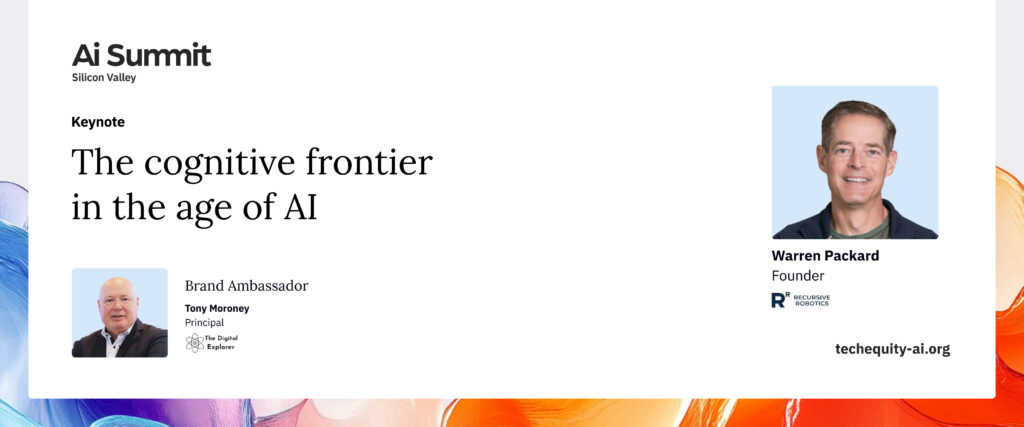
As a brand ambassador for the TechEquity Ai Summit, it was refreshing to see that Warren Packard did not deliver a conventional motivational keynote.
What he offered instead was rarer and more valuable: a calm, intellectually rigorous confrontation with inevitability. His reflections at the Summit, as captured in The Cognitive Frontier in the Age of AI, reminded the audience that technological progress does not wait for consensus, comfort, or readiness.
It advances—unconcerned with our anxieties—while demanding that we mature alongside it.
The comfortable myth of human exceptionalism
For decades, organisations have insulated themselves with a quiet assumption: that human cognition remains categorically distinct from that of machines.
AI, in this telling, is a tool—powerful, yes, but ultimately subordinate. Creativity, judgment, empathy, and meaning-making are presumed safe behind an invisible moat.
The moat is eroding.
What Packard’s cognitive scorecard implicitly reveals is not that machines have “caught up,” but that the boundary was always more porous than we cared to admit.
Memory, perception, reasoning, communication, even emotional attunement—these were never mystical properties. They were processes. And processes, once formalised, invite replication.
The status quo persists not because it is accurate, but because it is comforting.
From automation to cognitive co-habitation
Most enterprises still frame AI in the language of efficiency: faster decisions, cheaper labour, automated workflows. This is managerial thinking applied to a civilisational shift. It misses the deeper transition now underway—from automation to cognitive cohabitation.
We are no longer designing systems that merely execute tasks.
We are shaping entities that participate in sensemaking. Multimodal models do not just “process inputs”; they interpret environments. Reasoning systems do not just solve problems; they decompose ambiguity. Agentic architectures do not just respond; they initiate.
The future organisation is not one in which humans are replaced, but one in which humans are no longer the sole cognitive actors.
This is not augmentation. It is plural intelligence.
Metacognition as the final threshold
Packard rightly identifies metacognition—thinking about thinking—as the missing piece in today’s AI systems.
Current models can simulate reflection, but they lack it. They generate responses that reflect reasoning without maintaining a stable, self-referential awareness of how or why those responses were produced.
History suggests, however, that thresholds of this kind rarely announce themselves clearly. They emerge indirectly, through the convergence of capabilities not originally designed to produce them.
Persistent memory architectures, expanding contextual continuity, agents coordinating other agents, and systems optimising not only outcomes but also aspects of their own internal strategies all point towards increasingly self-referential behaviour.
Whether this ultimately constitutes metacognition remains an open question—not a forecast, but a hypothesis that deserves serious consideration.
If such a threshold is crossed, it is unlikely to arrive as a sudden awakening.
There will be no clear moment of declaration. Instead, it will appear ordinary at first: a system that questions its own confidence, revises its reasoning mid-task, or strategically defers judgment. Only later will the consequences become visible.
At that point, long-held organisational assumptions—about oversight, accountability, authorship, and control—will begin to fracture. Not because machines have become autonomous in a dramatic sense, but because cognition itself will no longer be singular.
The critical question, then, is not whether this threshold will be crossed, but whether our institutions are philosophically prepared to recognise it when it occurs.
Three quietly radical paths
One future preserves the illusion of control. AI remains framed as infrastructure—powerful but contained. Organisations double down on dashboards, governance layers, and human “sign-off,” even as real cognition occurs elsewhere. This is the path of symbolic leadership and declining relevance.
Another future fragments—cognitive authority fragments across tools, agents, and platforms. Decision-making accelerates beyond human tempo. Organisations become reactive, ethical frameworks lag, and trust erodes—not because AI is malicious, but because meaning is no longer anchored.
A third future is harder—and rarer. It treats AI as a cognitive counterpart. Leaders evolve from decision-makers into sense-stewards. Strategy shifts from prediction to orientation. Education pivots from knowledge transfer to epistemic humility. In this future, human value is not protected by superiority but by responsibility.
The real risk is not superintelligence
The true danger is not that machines will outthink us. It is that we will continue to think too small.
As Packard observed, science proceeds regardless of our hesitation. The question, then, is not whether AI will become more capable—but whether leadership, governance, and culture will become more philosophically literate.
As he noted, alignment is undefinable because humanity itself remains unresolved. Pretending otherwise is the real hallucination.
Leading at the cognitive frontier
This moment demands more than adoption strategies and ethics committees. It demands a re-examination of what leadership means in an era of non-human cognition.
If you sit on a board, ask not how AI improves performance—but how it reshapes judgment. If you lead an enterprise, ask not where AI saves costs—but where it changes meaning. If you design systems, ask not whether they are powerful—but whether they are worthy of trust.
The cognitive frontier is not ahead of us. We are already within it.
The only remaining question is whether we lead consciously—or drift into futures we never chose, intelligently.
Source and full original version available here:
https://www.linkedin.com/pulse/metacognition-true-ai-inflection-point-tony-moroney-l3ybe/?trackingId=HovBMinOTzGkDxkoGnwiNA%3D%3D