
Humanoid robotics is crossing a long-awaited threshold. In 2025, these machines are learning, adapting, and operating alongside people as AI, sensors, and scaled manufacturing converge.
Where is healthcare AI funding going?
Humanoid robotics refers to robots designed to replicate human form and function, not just in shape, but in mobility, dexterity, and perception. Unlike industrial robots built for repetitive, pre programmed tasks or service robots optimized for single functions, humanoids are intended to interact within human environments, performing diverse activities that require contextual understanding and adaptable behavior. Their core differentiator is versatility, they can walk, see, manipulate, and learn, bridging artificial intelligence with physical agency.
Humanoid is a cross category, orthogonal form factor rather than a single sector, so a humanoid system can show up in industrial, service, healthcare, or consumer settings depending on the use case.
Humanoid robotics funding accelerates
Funding for humanoid focused startups and R&D programs is estimated to have exceeded $1.3B in H1 2025.
- Figure AI announced a $1B round in 2025.
- Apptronik raised about $403M in 2025.
- Agility Robotics was reported to raise roughly $400M in early 2025.
- Tesla Optimus investment is substantial but undisclosed as part of Tesla internal programs.
- Boston Dynamics, Sanctuary AI, and Fourier Intelligence continued to fund expansion and pilots with amounts that were not all publicly itemized for 2025.
Leading players, Tesla, Figure AI, Apptronik, Boston Dynamics, Agility Robotics, Sanctuary AI, and Fourier Intelligence, are racing to prove both functional dexterity and scalable production. While robotics remains diversified across healthcare, agriculture, and logistics, humanoid systems are becoming a focal point for investors seeking the next leap in embodied AI.
Key humanoid players with the highest 2025 funding

1. Figure A
In 2025, Figure AI raised $1B in funding.
Series unknown | Total funding: not disclosed
Figure AI is developing a general purpose humanoid platform focused on dexterous manipulation and task learning in human environments. The company integrates vision, language, and control to enable robots to follow natural instructions and generalize from demonstrations. Early commercialization targets factory workcells and material handling, with a roadmap toward broader service and consumer use once reliability and cost curves improve.

2. Apptronik
In 2025, Apptronik raised $403M in funding.
Series A and extensions | Total funding: $403M
Apptronik builds Apollo, a human scale humanoid designed for industrial workflows such as pick assist, pallet moves, and line support. The team emphasizes manufacturability, modular actuators, and field serviceability to speed deployment and reduce downtime. Partnerships focus on warehouse and light manufacturing pilots that can be repeated across sites with minimal customization.
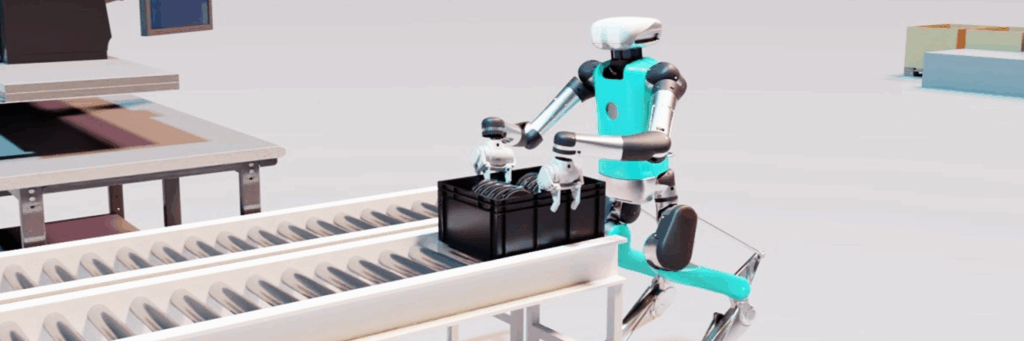
In early 2025, Agility Robotics was reported to raise roughly $400M.
Series unknown | Total funding: not disclosed
Agility Robotics develops Digit, a bipedal humanoid aimed at repetitive warehouse tasks like tote handling and case movement. The company’s approach prioritizes reliability, uptime, and integration with existing WMS systems to deliver predictable throughput. Production scaling and multi site pilots are core to its plan to transition from showcase demos to durable, revenue generating deployments.
Where funding has flowed?
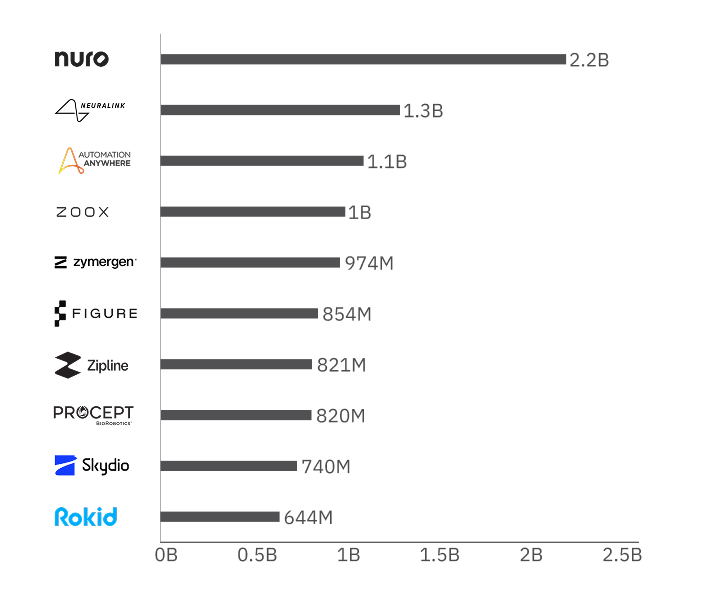
Brief review: This chart, from our earlier post The rise of smarter machines: Where AI in robotics is headed in 2025, shows top funding totals for AI in robotics from 2021 to 2025.
Among these companies, Figure AI is the only one focused on humanoid platforms(Data for the chart were compiled as of June 2025, prior to the inclusion of Figure’s subsequent $1B round), while the rest span autonomous vehicles, drones, surgical systems, and software automation. That contrast reinforces why humanoids remain a cross-cutting form factor inside the broader robotics market rather than a single sector.
Tesla Optimus: Redefining learning and autonomy
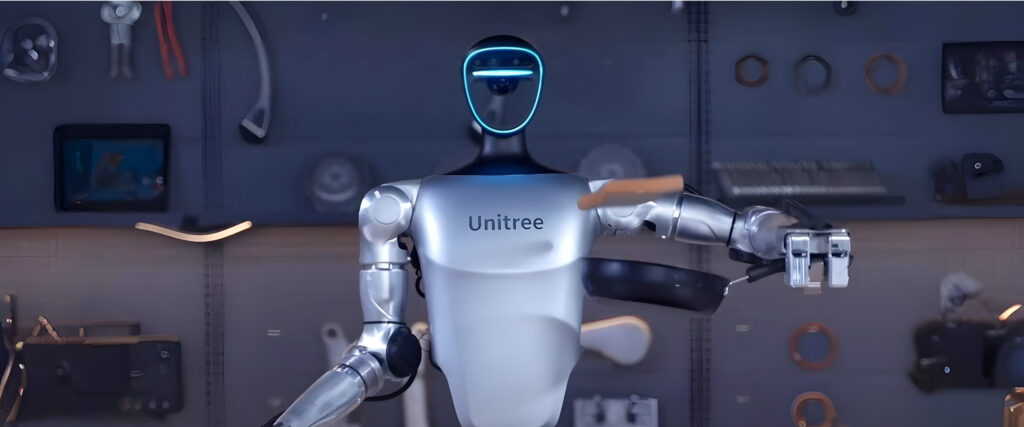
The turning point came on October 7, 2025, when Elon Musk unveiled major progress with Tesla’s Optimus Gen 3 humanoid. In a live demonstration, Optimus performed complex tasks such as Kung Fu sequences, cooking, and household cleaning, all learned autonomously through observation rather than explicit coding¹²³⁵⁶⁷.
This marks a shift from earlier demos that relied on human teleoperation. Optimus now learns by watching human demonstrations and online videos, pushing robotic intelligence toward self directed generalization¹²⁴.
Musk announced plans to scale production to 5,000 units by the end of 2025, projecting that humanoid robotics could account for 80% of Tesla’s future value⁴. He added that everyone will want their Optimus buddy, maybe two, and outlined long term revenue potential measured in the tens of trillions of dollars from humanoid platforms⁴. While forecasts are bold, the demo showed smoother motion control, improved balance, and more precise object interaction, placing Tesla among the leaders in autonomous embodiment¹³⁵⁶.
The global race for humanoid intelligence
Tesla’s milestone has intensified a worldwide race.
- Apptronik’s Apollo targets industrial and warehouse deployment.
- Figure AI’s Figure 02 blends large language models with motor control for natural language tasking.
- Boston Dynamics, collaborating with Toyota Research Institute, is evolving Atlas toward general purpose manipulation via AI driven behavioral models.
- Sanctuary AI’s Phoenix emphasizes cognitive generalization, combining reinforcement learning with symbolic reasoning.
How humanoids map to sectors
- Figure and Tesla Optimus: often AI powered robotics and autonomous systems, when aimed at factories, also industrial robotics.
- Agility Robotics, Digit: industrial robotics for warehouses plus AI powered control.
- Sanctuary and Fourier: primarily AI powered robotics, sometimes service robotics.
- Medical humanoid assistants, future: would fall under healthcare robotics.
- Home companions: consumer robotics, which is still a tiny share today.
Shared ambition, humanoid robots that are trainable rather than programmed, adapting in real time to new environments and tasks.
Challenges, impact, and what comes next
1. Key challenges to deployment
Fully autonomous humanoids must overcome reliability in messy settings, limited energy density, affordability constraints, and the need for rigorous safety and ethics frameworks. A demonstration is not the same as deployment, and long duration performance in real environments remains the bar to clear.
2. Societal impact to watch
As humanoids shift from industrial assistants to domestic companions, they raise questions about labor, productivity, accessibility, and care. Trust, transparency, and coexistence will shape adoption in public and private spaces, along with training, insurance, and compliance practices.
3. What comes next
Commercial trials in manufacturing, logistics, and care are slated to expand through 2026. Early standards efforts are forming across the United States, Japan, and South Korea. Investor interest is likely to grow as pilots validate business cases. If 2024 was speculation and 2025 is demonstration, 2026 could become the beginning of scaled deployment.
Join the conversation this November
Curious where humanoid robotics is headed next?
Join us at the TechEquity Ai Summit 2025 where the focus will expand to include humanoid AI, embodied autonomy, and human robot collaboration and meet the founders, engineers, and policymakers shaping this new frontier.
 Location: Plug and Play Tech Center, Sunnyvale, CA
 Date: November 7–8, 2025
 Register now: techequity-ai.org/registration
Source note: All funding amounts and company totals cited in this article, unless otherwise attributed, are drawn from Crunchbase data as of 2025.
References:
1. Times of India. “Tesla Optimus learning Kung Fu: Elon Musk’s humanoid robot stuns with human-like moves and balance.” Times of India, October 6, 2025. Available at: https://timesofindia.indiatimes.com/technology/tech-news/tesla-optimus-learning-kung-fu-elon-musks-humanoid-robot-stuns-with-human-like-moves-and-balance-watch/articleshow/124337395.cms (accessed October 8, 2025).
2. Teslarati. “Elon Musk teases previously unknown Tesla Optimus capability.” Teslarati, October 5, 2025. Available at: https://www.teslarati.com/elon-musk-teases-previously-unknown-tesla-optimus-capability/(accessed October 8, 2025).
3. Tech Times. “Tesla’s Optimus Humanoid Robot Surprises With Kung Fu Skills.” Tech Times, October 5, 2025. Available at: https://www.techtimes.com/articles/312175/20251006/teslas-optimus-humanoid-robot-surprises-kung-fu-skills.htm (accessed October 8, 2025).
4. Business Insider. “The Story of Optimus, Tesla’s Humanoid Robot.” Business Insider, September 8, 2025. Available at: https://www.businessinsider.com/optimus-tesla-humanoid-robot-elon-musk-growth-plans-2025-9 (accessed October 8, 2025).
5. YouTube. “Elon Musk SHOCKED Tesla Bot Gen 3 Finally LEARNING Kung Fu.” YouTube, October 5, 2025. Available at: https://www.youtube.com/watch?v=r2yZDbIquaQ (accessed October 8, 2025).
6. Instagram. “Tesla CEO Elon Musk shares a new video of the Tesla Optimus robot.” Instagram, October 6, 2025. Available at: https://www.instagram.com/p/DPepSaaDdNY/ (accessed October 8, 2025).
7. OpenTools AI. “Tesla’s Optimus Robot Struts its Kung Fu Stuff! | AI News.” OpenTools AI, October 4, 2025. Available at: https://opentools.ai/news/teslas-optimus-robot-struts-its-kung-fu-stuff (accessed October 8, 2025).