
Editor’s note:
This article was originally written by Tony Moroney and is reposted here with permission. It draws on ideas discussed at the TechEquity Ai Summit 2025 and is shared to prompt deeper reflection on how organisations approach AI-led change.
Before challenging the status quo, it is worth acknowledging those who illuminate its cracks with clarity and courage.
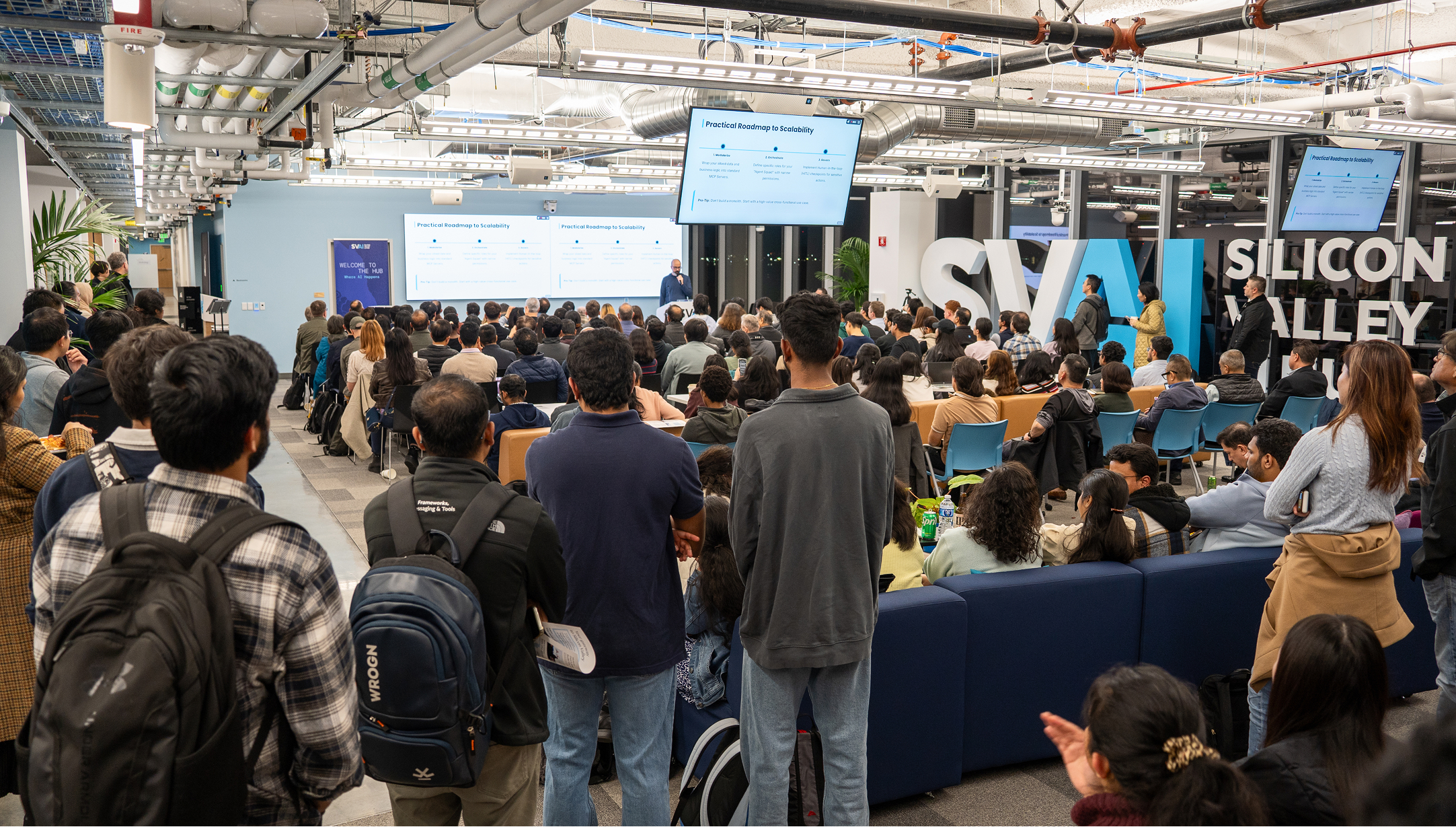
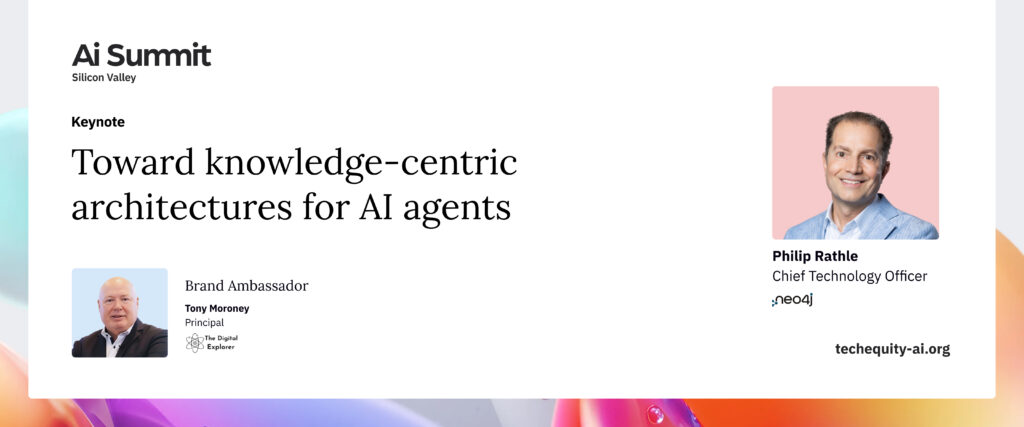
At the Ai Summit by TechEquity Ai – Silicon Valley, Philip Rathle offered precisely that kind of inspiration: not a futurist spectacle but a grounded provocation rooted in how knowledge, context, and judgment must evolve if AI is to matter where the stakes are highest.
His reflections on knowledge-centric architectures for AI agents did more than describe a technical pathway—they quietly questioned the prevailing assumptions underpinning enterprise AI today.
The Illusion at the Heart of Enterprise AI
We like to believe that scale equals intelligence. That more parameters, more data, and more automation inevitably lead to better decisions.
This belief has become the unspoken doctrine of enterprise AI. Yet beneath the surface, a tension is building.
Today’s generative systems are eloquent yet fragile. They perform brilliantly in low-stakes environments yet falter when confronted with accountability, context, and consequences.
The problem is not that these systems are insufficiently powerful. It is that they are structurally incomplete.
The prevailing AI stack prioritises fluency over understanding.
It assumes that probabilistic reasoning alone can replace knowledge, judgment, and discernment. In doing so, it quietly decouples intelligence from responsibility.
When Fluency Collides with Consequence
As AI systems move closer to operational decision-making—advising employees, guiding customers, and shaping outcomes—the cost of error shifts dramatically.
In these moments, hallucination is no longer a curiosity; it is a liability. Opacity is no longer tolerable; it is a failure of governance.
What we are witnessing is not a tooling gap but a conceptual one.
Enterprises have built AI systems that can speak, but not ones that truly know. They can generate answers, but they cannot reliably explain why those answers are appropriate in a given context, for a given actor, at a given moment.
This is where the current paradigm begins to fracture.
The Emergence of Knowledge-Centric Intelligence
A different architecture is quietly taking shape—one that treats knowledge not as a static repository but as a living, connected layer that agents can reason over.
In this emerging model, intelligence is no longer confined to the model itself. It is distributed across a knowledge layer that encodes relationships, constraints, histories, and meaning.
Here, AI agents do not merely retrieve information; they navigate context. They understand how entities relate, how decisions propagate, and why certain actions are permissible while others are not. Explainability is not bolted on after the fact—it is inherent in the structure.
This shift marks a deeper reframing of intelligence. It echoes how humans operate: creativity tempered by memory, intuition balanced by reasoning.
The future AI stack begins to resemble a system of judgment, not just generation.
Possible Futures: Three Paths Ahead
One future is comfortable yet brittle. Enterprises continue to scale generative systems, layering governance and controls on top, hoping that guardrails can compensate for architectural fragility. AI remains impressive yet perpetually constrained to advisory roles.
A second future is corrective. Organisations recognise that intelligence without knowledge is unsustainable. They invest in architectures that bind AI agents to the enterprise context, embedding reasoning, traceability, and discernment at its core. AI becomes operationally trustworthy, not merely rhetorically powerful.
A third future is transformational. Here, enterprises rethink decision-making itself. AI agents become embedded collaborators within knowledge ecosystems, augmenting rather than replacing human judgment. Strategy, operations, and learning converge around shared, evolving models of reality.
The choice between these futures is not technological; it is philosophical.
The Real Disruption Is Organisational
What ultimately stands in the way is not tooling maturity, but mindset.
Knowledge-centric architectures demand that organisations confront uncomfortable truths: that data silos reflect power structures, that ambiguity cannot always be automated away, and that accountability must be designed, not assumed.
This is why the disruption ahead is quieter than expected. It will not arrive as a sudden breakthrough but as a gradual reconfiguration of how enterprises think, decide, and learn.
Those who move first will not only deploy better AI. They will also build institutions capable of thinking alongside it.
Reclaim Intelligence from Automation
The moment we are in demands more than experimentation. It demands intentional design.
If you are a board member, ask not how many AI tools your organisation has deployed, but how intelligence is governed within them. If you are an executive, question whether your AI systems understand your business—or merely your language. If you are a technologist, resist the temptation to optimise fluency at the expense of meaning.
The future of AI will not be won by those who automate fastest, but by those who design for judgment, context, and consequence.
It is time to stop asking what AI can generate—and to decide what it should be allowed to know, and why.
Source and full original version available here:
https://www.linkedin.com/pulse/from-models-meaning-knowledge-new-operating-system-tony-moroney-yr6be/?trackingId=DO%2F5QMZWQAuCHRhb9KmWTQ%3D%3D